

Frithjof Schuon Archive

A Resource on Frithjof Schuon’s Life and Teachings
This site is the most comprehensive repository of information pertaining to the life and work of Frithjof Schuon (1907-1998); materials include published articles, personal correspondence, private papers, poems, photographs, and works of art.
Frithjof Schuon is the preeminent spokesman of a school of thought that focuses on the expression and explanation of the Perennial Philosophy. This philosophy expresses the timeless metaphysical truths underlying the diverse religions; its written sources include the revealed Scriptures as well as the writings of the great spiritual masters. Because these truths are permanent and universal, the point of view may thus be called “Perennialist.” The Perennial Philosophy is an important perspective that can inform the study of Comparative Religion, Anthropology, Art, Literature, and many related areas.
Schuon was a philosopher in the tradition of Plato, Shankara, and Eckhart, and he wrote over two dozen books on religion, metaphysics, sacred art, and the spiritual path. Describing Schuon’s first book, The Transcendent Unity of Religions, Nobel laureate T. S. Eliot wrote, “I have met with no more impressive work in the comparative study of Oriental and Occidental religion”, and world-renowned religion scholar Huston Smith said of Schuon, “The man is a living wonder; intellectually apropos religion, equally in depth and breadth, the paragon of our time”. Schuon’s books have been translated into over a dozen languages and are respected by academic and religious authorities alike. Schuon’s writings remain unequaled in setting forth the principles of perennialist thought as well as their applications on the spiritual, aesthetic, and other related levels.
Besides his accomplishments as an author, Frithjof Schuon was also a gifted artist and poet. His art and his poetry flowed naturally from his awareness of God’s Presence in creation. Catalogue notes from a museum display of Schuon’s art explain that “springing as they do from his rich and unique personality, Schuon’s paintings…have a rare value, not only as regards artistic merit but above all because of their gift for manifesting the human soul at its noblest and most beautiful—hence, as a vehicle for Truth.” The sense of the sacred figures as much in Schuon’s art and poetry as in his philosophical writings.
The story of Schuon’s life presented in these pages demonstrates how his own intellect, personality, and actions reflected the elevated metaphysics, spiritual insights, and artistic creations that comprised his body of work.
This online resource brings together, through a survey of his many-faceted dimensions, Frithjof Schuon’s important contributions to the manifestations of the timeless Truth.
Featured Books
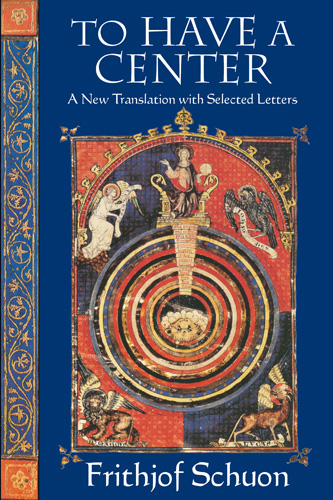
To Have a Center: A New Translation with Selected Letters
In this new edition of his powerfully original work, Schuon covers an array of metaphysical, cosmological, and anthropological subjects.
Featured Poems
Adastra and Stella Maris: Poems by Frithjof Schuon-Last Word
The book comes to an end, but not the singing;It lies in space and time and in all things,And yet is spaceless, timeless, beyond form —It is the content and radiance of our existence.The signs of God have their own speech;Thou hear’st it or thou hear’st it not.This...
Adastra and Stella Maris: Poems by Frithjof Schuon-Bodhisattva
The Bodhisattva’s graces, it is said,Extend much further than the spoken word —His body is the open house of his Enlightenment,Bestowing upon us its saving radiance.To give is more blessèd than to receive.Radiate, O Bodhisattva, what the heart desires.What thou hast...
Adastra and Stella Maris: Poems by Frithjof Schuon-Women
Wise Solomon had temples builtTo foreign gods, for his belovèd wives;With loving sweetness Magdalene pouredSpikenard oil on Jesus’ feet.On Dante’s thorny path of lifeRavenna’s noble women were a grace.The eternal feminine I wish to praise —Woman’s solace is a favor...
Adastra and Stella Maris: Poems by Frithjof Schuon-Soul Picture
This you must understand: I wish to feel ÂnandaIn all refreshing earthly things:A tree in bloom, a noble maiden,A love-song that delights the soul.And on the other hand: I wish to find refugeFrom all distractions of the mind;O blissful cessation of fleeting thoughts...
Featured Articles
Nigra sum sed Formosa: Mort et vie spirituelle chez Frithjof Schuon
Made in the Image – Schuon’s Theomorphic Anthropology
The theomorphic nature of man is a central theme in the oeuvre of Frithjof Schuon. Scott surveys Schuon’s key theomorphic teachings while touching upon the symbolism of the body and man in the wider context. Scott applies three categories within which he examines Schuon’s teachings on man’s theomorphic form (i.e. the body): (1) man’s divinity and animality, (2) the symbolism of the sexes, and (3) the meaning of sacred nudity.
La notion d’ésotérisme chez Frithjof Schuon
“Standing Unshakably in the True” – A Commentary on the Teachings of Frithjof Schuon
Frithjof Schuon’s work can be viewed as explorations of and elaborations upon four essential realities: the “a doctrine of Truth or Reality, and a method of Integration or Realization through Prayer leading to inner beauty or Virtue, or outer goodness or Beauty.” Illustrations of Schuon’s thoughts on these is taken primarily from his didactic poems, adding the element of beauty of expression to the clarity of metaphyical exposition for which he was known.