

Frithjof Schuon Archive

A Resource on Frithjof Schuon’s Life and Teachings
This site is the most comprehensive repository of information pertaining to the life and work of Frithjof Schuon (1907-1998); materials include published articles, personal correspondence, private papers, poems, photographs, and works of art.
Frithjof Schuon is the preeminent spokesman of a school of thought that focuses on the expression and explanation of the Perennial Philosophy. This philosophy expresses the timeless metaphysical truths underlying the diverse religions; its written sources include the revealed Scriptures as well as the writings of the great spiritual masters. Because these truths are permanent and universal, the point of view may thus be called “Perennialist.” The Perennial Philosophy is an important perspective that can inform the study of Comparative Religion, Anthropology, Art, Literature, and many related areas.
Schuon was a philosopher in the tradition of Plato, Shankara, and Eckhart, and he wrote over two dozen books on religion, metaphysics, sacred art, and the spiritual path. Describing Schuon’s first book, The Transcendent Unity of Religions, Nobel laureate T. S. Eliot wrote, “I have met with no more impressive work in the comparative study of Oriental and Occidental religion”, and world-renowned religion scholar Huston Smith said of Schuon, “The man is a living wonder; intellectually apropos religion, equally in depth and breadth, the paragon of our time”. Schuon’s books have been translated into over a dozen languages and are respected by academic and religious authorities alike. Schuon’s writings remain unequaled in setting forth the principles of perennialist thought as well as their applications on the spiritual, aesthetic, and other related levels.
Besides his accomplishments as an author, Frithjof Schuon was also a gifted artist and poet. His art and his poetry flowed naturally from his awareness of God’s Presence in creation. Catalogue notes from a museum display of Schuon’s art explain that “springing as they do from his rich and unique personality, Schuon’s paintings…have a rare value, not only as regards artistic merit but above all because of their gift for manifesting the human soul at its noblest and most beautiful—hence, as a vehicle for Truth.” The sense of the sacred figures as much in Schuon’s art and poetry as in his philosophical writings.
The story of Schuon’s life presented in these pages demonstrates how his own intellect, personality, and actions reflected the elevated metaphysics, spiritual insights, and artistic creations that comprised his body of work.
This online resource brings together, through a survey of his many-faceted dimensions, Frithjof Schuon’s important contributions to the manifestations of the timeless Truth.
Featured Books
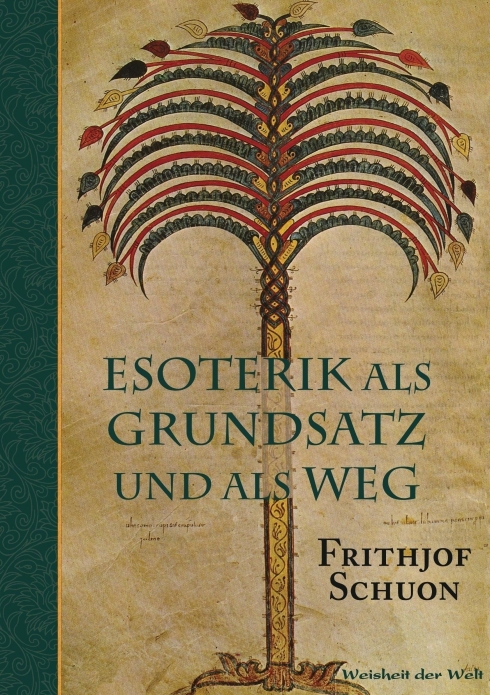
Esoterik als Grundsatz und als Weg (e-book)
The content includes a profound metaphysical reflection on the double face of the world based on the concept of the veil, insights into cosmology faithful to tradition based on a doctrine of numbers, and fundamental and practical essays on anthropology: virtues, sexuality, love of God and love of neighbor.
Featured Poems
Adastra and Stella Maris: Poems by Frithjof Schuon-Home-coming
Apokatastasis: return of all values,Of all good beings and good thingsInto the Lap of God, where everything was and will beEternally, so that their songs of praise resound.What God created cannot become eternalOutside of Him. He does not wish to destroy it;Within His...
Adastra and Stella Maris: Poems by Frithjof Schuon-A Myth
It has been taught: one of the highest angelsWas hurled down — the highest of them all,“Bearer of Light.” But this cannot be;A true angel of God can never fall.From the beginning, Lucifer bore in himselfThe possibility of the Fall, like descending woe —Thus did he...
Adastra and Stella Maris: Poems by Frithjof Schuon-His Will
Mâ shâ’ Allâh: God doeth what He will.This means that He is free — so one might think —Because He is the Lord; yet the meaning is this:You cannot know the cause of everything.Many worthy theologiansShaped God’s Image into a human form.God is not a tyrant, quod absit....
Adastra and Stella Maris: Poems by Frithjof Schuon-The Ray
A dream-web in a thousand webs of dreams,With joy comes grief; and death overcomes life —The world-wheel turns without beginning, without aim,As the mystery of Being wills.And yet there is a power that, within this play, can win:It is the ray come from Above, and from...
Featured Articles
Foreword to “Language of the Self”
V. Raghavan (1908-1979) wrote this “Foreword” to Frithjof Schuon’s book Language of the Self. It appeared in the first edition in India, and then later in World Wisdom’s 1999 edition. The foreword summarizes Schuon’s perspective in a number of areas as divergent as the transcendent unity of religions, the modern world, metaphysics, and his approach to and appreciation of Hinduism.
Book Review of “Understanding Islam”
The Elect and the Predestination of Knowledge: ‘Esoterism’ and ‘Exclusivism’: A Schuonian Perspective
The author of the essay states his purpose thus: “This paper considers the idea of the elite, or elect, with respect to the problems of Predestination and the notion of the exclusivity of esotericism. It is our opinion that the questions raised here can only be resolved in light of the metaphysical knowledge that is the proper subject of esotericism, where, as said, this is understood as the sophia perennis. Frithjof Schuon stands as the pre-eminent voice of the sophia perennis for our day and age and it is thus that this paper is largely a reiteration of what he has said on these points.”
The Mystery of the Two Natures
Combining a Socratic and a personal approach, Cutsinger looks to the writings and insights of Frithjof Schuon to examine “how in good conscience can a traditional Christian accept the idea that there is a ‘transcendental unity of religions’?” The author finds answers in a deeper understanding of Christ’s two natures: human and Divine.