

Frithjof Schuon Archive

A Resource on Frithjof Schuon’s Life and Teachings
This site is the most comprehensive repository of information pertaining to the life and work of Frithjof Schuon (1907-1998); materials include published articles, personal correspondence, private papers, poems, photographs, and works of art.
Frithjof Schuon is the preeminent spokesman of a school of thought that focuses on the expression and explanation of the Perennial Philosophy. This philosophy expresses the timeless metaphysical truths underlying the diverse religions; its written sources include the revealed Scriptures as well as the writings of the great spiritual masters. Because these truths are permanent and universal, the point of view may thus be called “Perennialist.” The Perennial Philosophy is an important perspective that can inform the study of Comparative Religion, Anthropology, Art, Literature, and many related areas.
Schuon was a philosopher in the tradition of Plato, Shankara, and Eckhart, and he wrote over two dozen books on religion, metaphysics, sacred art, and the spiritual path. Describing Schuon’s first book, The Transcendent Unity of Religions, Nobel laureate T. S. Eliot wrote, “I have met with no more impressive work in the comparative study of Oriental and Occidental religion”, and world-renowned religion scholar Huston Smith said of Schuon, “The man is a living wonder; intellectually apropos religion, equally in depth and breadth, the paragon of our time”. Schuon’s books have been translated into over a dozen languages and are respected by academic and religious authorities alike. Schuon’s writings remain unequaled in setting forth the principles of perennialist thought as well as their applications on the spiritual, aesthetic, and other related levels.
Besides his accomplishments as an author, Frithjof Schuon was also a gifted artist and poet. His art and his poetry flowed naturally from his awareness of God’s Presence in creation. Catalogue notes from a museum display of Schuon’s art explain that “springing as they do from his rich and unique personality, Schuon’s paintings…have a rare value, not only as regards artistic merit but above all because of their gift for manifesting the human soul at its noblest and most beautiful—hence, as a vehicle for Truth.” The sense of the sacred figures as much in Schuon’s art and poetry as in his philosophical writings.
The story of Schuon’s life presented in these pages demonstrates how his own intellect, personality, and actions reflected the elevated metaphysics, spiritual insights, and artistic creations that comprised his body of work.
This online resource brings together, through a survey of his many-faceted dimensions, Frithjof Schuon’s important contributions to the manifestations of the timeless Truth.
Featured Books
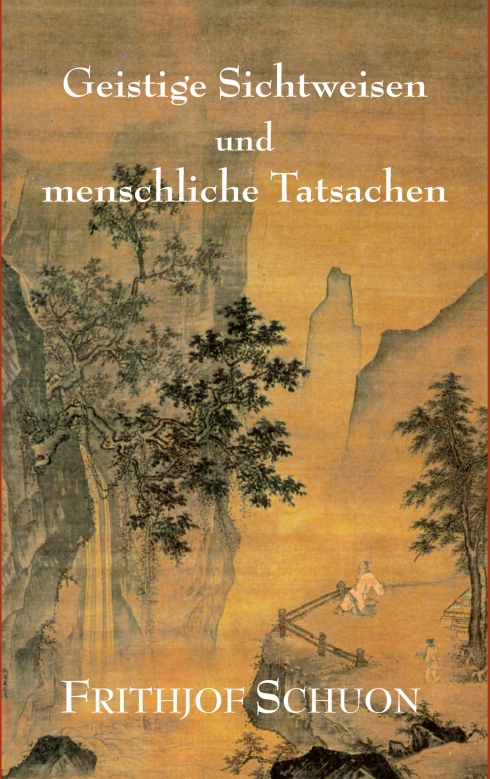
Geistige Sichtweisen und menschliche Tatsachen (e-Book)
“Geistige Sichtweisen und menschliche Tatsachen” consists of reflections on lore and modern civilization, art, spiritual life, metaphysics and the virtues.
Featured Poems
Adastra and Stella Maris: Poems by Frithjof Schuon-Triple Harmony
“Women, perfumes and prayerHas God made lovable to me” — thus spoke the Prophet.Women: for they embody both goodness and love;Perfumes: for they are blessings flowingFrom the things imbued with God.And prayer: it is the flower of existence.
Adastra and Stella Maris: Poems by Frithjof Schuon-Religio
Discern what is good in God’s eyes,Whether thou be Jew, Christian or Moslem;Religion does not mean persecuting others,Religio is what binds us to God —And nothing else. The world needs many forms —In God alone are the norms of Eternal Truth.From both sources thou...
Adastra and Stella Maris: Poems by Frithjof Schuon-Symbolism
A black holy man once said to me,There are different paths that lead to Allah:He is the Center, and the different faithsAre like spokes on the Spirit’s wheel.And each human soul is a Way:God wanted a thousand mirrors for the True.O would that man, in his inmost...
Adastra and Stella Maris: Poems by Frithjof Schuon-Distinguo
Thine ego should not be enclosed in Mâyâ;Thou shouldst soar above the things of the earth.Even if thou lovest wine, woman, and song —In Âtmâ is thy true and deepest life.Poems, the play of lute and noble dance —Not noise and wantonness in crowded taverns.Beauty and...
Featured Articles
The ‘Preface’ by Seyyed Hossein Nasr to “Dimensions of Islam”
Dr. Seyyed Hossein Nasr uses this “Preface” to explain that Frithjof Schuon’s writings on Islam, in this book as well as in others, is noteworthy for its focus on the “integral message” of the Islamic tradition. Schuon’s analyses are, here as elsewhere, free of academic superficialities, bring to light “the most inward aspect of the Islamic message.”
A Knowledge That Wounds Our Nature: The Message of Frithjof Schuon
This essay’s objective is to “enter … into Schuon’s own perspective, to understand him on his own terms, and to see how he envisions certain crucial ideas” and to explore why Schuon’s work is at once both provocative and inviting to so many readers.
The Basis of Religion and Metaphysics: An Interview with Frithjof Schuon
This wide-ranging interview with Frithjof Schuon covers “the transcendent unity of religions,” metaphysics, spiritual practice, virtue, sacred art, beauty, esoterism, the American Indian traditions, sacred nudity, and more.
A Sage for the Times: The Role and the Oeuvre of Frithjof Schuon
Besides a summary of Frithjof Schuon’s role in the school of traditionalist thought, and his groundbreaking work, Oldmeadow’s essay also includes interesting sections on Coomaraswamy and Guénon, the other two seminal authors of this school of thought.