

Frithjof Schuon Archive

A Resource on Frithjof Schuon’s Life and Teachings
This site is the most comprehensive repository of information pertaining to the life and work of Frithjof Schuon (1907-1998); materials include published articles, personal correspondence, private papers, poems, photographs, and works of art.
Frithjof Schuon is the preeminent spokesman of a school of thought that focuses on the expression and explanation of the Perennial Philosophy. This philosophy expresses the timeless metaphysical truths underlying the diverse religions; its written sources include the revealed Scriptures as well as the writings of the great spiritual masters. Because these truths are permanent and universal, the point of view may thus be called “Perennialist.” The Perennial Philosophy is an important perspective that can inform the study of Comparative Religion, Anthropology, Art, Literature, and many related areas.
Schuon was a philosopher in the tradition of Plato, Shankara, and Eckhart, and he wrote over two dozen books on religion, metaphysics, sacred art, and the spiritual path. Describing Schuon’s first book, The Transcendent Unity of Religions, Nobel laureate T. S. Eliot wrote, “I have met with no more impressive work in the comparative study of Oriental and Occidental religion”, and world-renowned religion scholar Huston Smith said of Schuon, “The man is a living wonder; intellectually apropos religion, equally in depth and breadth, the paragon of our time”. Schuon’s books have been translated into over a dozen languages and are respected by academic and religious authorities alike. Schuon’s writings remain unequaled in setting forth the principles of perennialist thought as well as their applications on the spiritual, aesthetic, and other related levels.
Besides his accomplishments as an author, Frithjof Schuon was also a gifted artist and poet. His art and his poetry flowed naturally from his awareness of God’s Presence in creation. Catalogue notes from a museum display of Schuon’s art explain that “springing as they do from his rich and unique personality, Schuon’s paintings…have a rare value, not only as regards artistic merit but above all because of their gift for manifesting the human soul at its noblest and most beautiful—hence, as a vehicle for Truth.” The sense of the sacred figures as much in Schuon’s art and poetry as in his philosophical writings.
The story of Schuon’s life presented in these pages demonstrates how his own intellect, personality, and actions reflected the elevated metaphysics, spiritual insights, and artistic creations that comprised his body of work.
This online resource brings together, through a survey of his many-faceted dimensions, Frithjof Schuon’s important contributions to the manifestations of the timeless Truth.
Featured Books
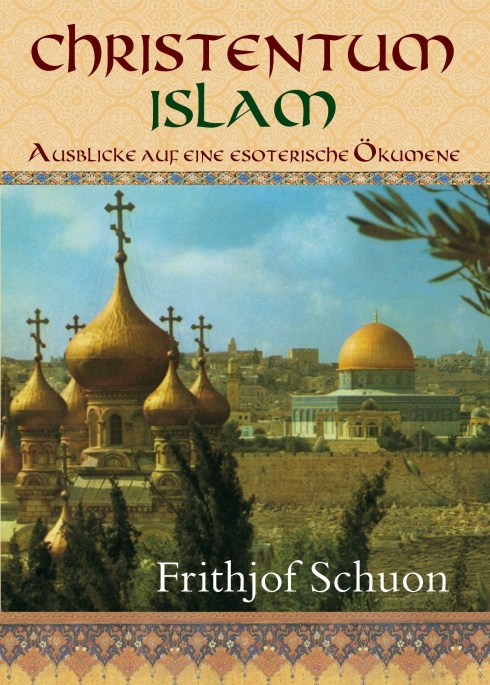
Christentum – Islam: Ausblicke auf eine esoterisch Ökumene
In this work, Frithjof Schuon compares Christianity and Islam and also looks at confessions within these world religions: Protestantism, Orthodoxy, and Shiism.
Featured Poems
Adastra and Stella Maris: Poems by Frithjof Schuon-Leila
Were I to see thee dance, Leila, my heart Would be enchanted and spellbound on its inward path.Were I to see thy face, I would forget myself —I could remember the world no more.Leila: angel of contemplation —I know not if thou art form or melody,A love-song, a golden...
Adastra and Stella Maris: Poems by Frithjof Schuon-Krishna
I would like to compare this wreath of songsWith Krishna’s flute, which sings of Âtmâ.O may it reach the hardened heartThat drinks of the cup of earthly folly!There is the gopis’ golden dance of love,Made pure and vivified by Krishna’s play;O may the soul bow to the...
Adastra and Stella Maris: Poems by Frithjof Schuon-Stella Matutina
The Morning Star rises out of the nightLike the goddess Venus from the foamOf the sea — a pearl, and then a woman;Profoundly feminine is Heaven’s wondrous Grace.She is mystery; she is not law,She is free divine forgiveness,From the deep waters of Infinity —And none...
Adastra and Stella Maris: Poems by Frithjof Schuon-Life’s Work
The work, a lifelong struggle — firstYouthful dreams: the True, the Beautiful,The Sacred, and the Great. Then dreamsCome true, that the Word might be heard.All this amid the shadows — will it shine or not?Does destiny wish that the Word grow wearyAnd weaker throughout...
Featured Articles
The Milk of the Virgin: the Prophet, the Saint and the Sage
This essay by Renaud Fabbri, from Sacred Web 20, explores certain misunderstandings about Schuon’s position: was he a prophet (instituting a new transcendent religion or primordial message), a saint (some have portrayed him as a Muslim saint operating within the structures of Sufism), or, as the author contends, a sage (based on the Platonic or Hindu model)? Emphasizing the Marian foundation of his teachings, the author argues that Schuon is best understood as being a paracletic spokesman of the sophia perennis and a shakta.
Remarks on Esoterism in the works of Frithjof Schuon
Patrick Laude summarizes “the main ideas presented by Schuon on the topic of esoterism, both in his published works and in some of his unpublished texts.” Laude presents a definintion of “esoterism” as understood by Schuon, how in Schuon’s work esoterism is viewed as connected with the exoteric religions, the religio perennis,” and esoterism in the spiritual life.
Frithjof Schuon And The Perennialist School
Introducing the Writings of Frithjof Schuon
This is the complete “Introduction” to the book — some other articles on this site are excerpted from this piece. It was written by Prof Seyyed Hossein Nasr for one of his most voluminous and important works, The Essential Frithjof Schuon (World Wisdom, 2005). In it, Dr Nasr covers salient features of Schuon’s work; Schuon’s place in the study of comparative religion; his central message or theme; Schuon’s thoughts on the “transcendent unity of religions”; his approach to epistemology and philosophy in general; and Schuon’s contributions to thought on art, beauty, the spiritual life, and many other topics. The “Introduction” ends with brief synopses of Schuon’s individual books. This is among the best summaries of the importance of Frithjof Schuon’s work in many areas of contemporary and traditional thought, written by one of the people best qualified for the task.