

Frithjof Schuon Archive

A Resource on Frithjof Schuon’s Life and Teachings
This site is the most comprehensive repository of information pertaining to the life and work of Frithjof Schuon (1907-1998); materials include published articles, personal correspondence, private papers, poems, photographs, and works of art.
Frithjof Schuon is the preeminent spokesman of a school of thought that focuses on the expression and explanation of the Perennial Philosophy. This philosophy expresses the timeless metaphysical truths underlying the diverse religions; its written sources include the revealed Scriptures as well as the writings of the great spiritual masters. Because these truths are permanent and universal, the point of view may thus be called “Perennialist.” The Perennial Philosophy is an important perspective that can inform the study of Comparative Religion, Anthropology, Art, Literature, and many related areas.
Schuon was a philosopher in the tradition of Plato, Shankara, and Eckhart, and he wrote over two dozen books on religion, metaphysics, sacred art, and the spiritual path. Describing Schuon’s first book, The Transcendent Unity of Religions, Nobel laureate T. S. Eliot wrote, “I have met with no more impressive work in the comparative study of Oriental and Occidental religion”, and world-renowned religion scholar Huston Smith said of Schuon, “The man is a living wonder; intellectually apropos religion, equally in depth and breadth, the paragon of our time”. Schuon’s books have been translated into over a dozen languages and are respected by academic and religious authorities alike. Schuon’s writings remain unequaled in setting forth the principles of perennialist thought as well as their applications on the spiritual, aesthetic, and other related levels.
Besides his accomplishments as an author, Frithjof Schuon was also a gifted artist and poet. His art and his poetry flowed naturally from his awareness of God’s Presence in creation. Catalogue notes from a museum display of Schuon’s art explain that “springing as they do from his rich and unique personality, Schuon’s paintings…have a rare value, not only as regards artistic merit but above all because of their gift for manifesting the human soul at its noblest and most beautiful—hence, as a vehicle for Truth.” The sense of the sacred figures as much in Schuon’s art and poetry as in his philosophical writings.
The story of Schuon’s life presented in these pages demonstrates how his own intellect, personality, and actions reflected the elevated metaphysics, spiritual insights, and artistic creations that comprised his body of work.
This online resource brings together, through a survey of his many-faceted dimensions, Frithjof Schuon’s important contributions to the manifestations of the timeless Truth.
Featured Books
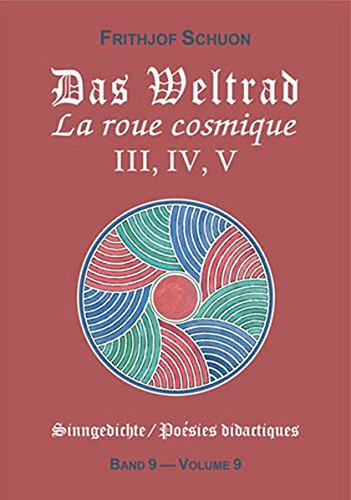
Das Weltrad 3, 4, 5
The German sense poems of Frithjof Schuon form a metaphysical and spiritual whole that unites the essential teachings of this master in a form as accessible as it is immediate.
Featured Poems
Adastra and Stella Maris: Poems by Frithjof Schuon-The Celebration
A worldly banquet: chandeliers glitter In the large hall — And brilliant society, ladies and gentlemen Sit down for the meal. They talk of everything and they talk of nothing — The wine is red, And so are the flowers. But no one, no one Thinks of death.
Adastra and Stella Maris: Poems by Frithjof Schuon-Contentment
To be content with God — these are weighty words.Do they mean that one should despise all things?This is hardly so. God created us to love us —But also for us to strive fervently toward the Sovereign Good.Within us shines a golden jewelAs soon as we remember That...
Adastra and Stella Maris: Poems by Frithjof Schuon-Upaya
There are two ways to draw you to the pathOf salvation, and to flee the Fall.Two sacred remedies: let me first namePlato and Shankara with their stern speech;Their teachings burn through foolish illusions —Then the sweet and magic flute of David and Krishna:To...
Adastra and Stella Maris: Poems by Frithjof Schuon-Trinitas
Spirit, Truth, Name — the three high marvelsIn which God wished to give Himself unto the world.Intellect, Doctrine, Sacrament —In their profundity thou shouldst immerse thyself,So that the meaning of thy nature be fulfilled.And may God guide the powers of thy mind...
Featured Articles
Frithjof Schuon et René Guénon
Un entretien avec Frithjof Schuon
À propos de « Trésors du Bouddhisme »
The Introduction by The Prince of Wales to the 2006 Sacred Web Conference
This is a transcript of The Prince of Wales’ videotaped introduction to the Sacred Web Conference, “Tradition in the Modern World,” presented on September 23, 2006, at the University of Alberta, Edmonton, Canada. Prince Charles begins his comments with: “In these uprooted times, there is a great need for constancy; a need for those who can rise above the clamour, the din and the sheer pace of our lives to help us to rediscover those truths that are immutable and eternal; a need for those who can speak of that eternal wisdom which is called the perennial philosophy.” The address continues to outline key points of Traditionalism and the Perennial Philosophy, supporting The Prince’s theme that there are real and positive applications of these points in “finding practical solutions to what, at first, seem to be impossible difficulties – and sometimes to speak for those whose voices are unheard amidst the clamour of Modernism.” The Prince’s insights demonstrate his thoughtful consideration of and interest in the worldview offered by the Perennial Philosophy.